


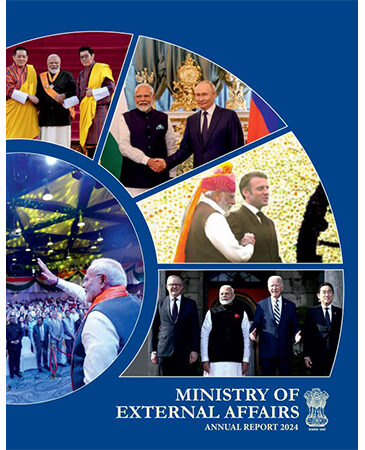
New Delhi, July 11, 2025: The Ministry of External Affairs (MEA) has released
its annual report for 2024, highlighting India’s key diplomatic engagements and
achievements. According to the report, India’s foreign policy demonstrated “vibrancy
and pragmatism” in advancing national interests amid a rapidly evolving global
landscape.
In the year 2024, India engaged actively with the world in advancing its national
interests amid a rapidly evolving global landscape. Indian foreign policy
demonstrated vibrancy and pragmatism, yielding significant achievements that alsoenhanced India’s global stature and goodwill, the Ministry of External Affairs wrote in
its annual report 2024 on Friday.
Bilateral engagements with like-minded partners were complemented by India’s
proactive initiatives and leadership in plurilateral and multilateral platforms.
The Ministry of External Affairs (MEA) played a pivotal role in steering India’s foreign
policy and global diplomacy towards pragmatic goals, it added.
India remained steadfast in expanding its strategic autonomy, championing
meaningful reforms of multilateral institutions, addressing the priorities of the Global
South, and safeguarding its security within the framework of the rules-based
international order. These efforts underscored India’s commitment to shaping a more
equitable and inclusive global governance framework.
The year witnessed continuing economic fluctuations, climate change impacts,
geopolitical tensions, and social disruptions, with persistent challenges on global
health and environmental fronts.
India remained actively engaged on the global stage, addressing major global
challenges through high-level discussions and collaborations.
This included strengthening partnerships bilaterally and active participation in notable
regional and global groupings such as the UN, G20, G7, Quad, SCO, and BRICS. By
virtue of being the preceding G20 President, India continued to work with Brazil
under the Troika grouping (India, Brazil, and South Africa).
Building on the work done during India’s G20 Presidency, Brazil identified three
priorities for 2024, which broadly involved social inclusion, energy transition, and the
reform of multilateral governance institutions.
The report notes that India remained actively engaged on the global stage,
addressing major global challenges through high-level discussions and
collaborations.
The MEA report highlighted PM Modi’s participation in the 19th G20 Summit in Rio de
Janeiro on 18-19 November. Prime Minister’s interventions were widely appreciated
across the spectrum of developed and developing countries for being human-centric,
constructive, and development-oriented.
This was also the first G20 Summit in which the African Union participated as a
permanent member, following its inclusion at the New Delhi G20 Summit in
September 2023. In August, India hosted the 3rd edition of the Voice of Global South
Summit in virtual format under the overarching theme ‘An Empowered Global South
for a Sustainable Future,’ MEA stated.
India also hosted the 3rd edition of the Voice of Global South Summit, which saw the
participation of 173 dignitaries from 123 Global South countries. During the summit,
PM Modi proposed a “global development compact” to promote sustainable
development in the Global South–the compact focuses on trade, capacity building,
technology sharing, and financial support.
The report highlights India’s commitment to combating terrorism, with the country
collaborating actively with the global community to counter terrorism in all its forms
and manifestations. India also reinforced its credentials as a reliable “first responder”
in crises, undertaking three major Humanitarian Assistance and Disaster Relief
(HADR) operations during the year.
Earlier in June, the Prime Minister participated in the Outreach Session of
the G7 Summit in Italy, where he engaged with global leaders on key global
challenges.

At the summit, PM Modi emphasised that technology must be guided by a human-
centric approach, highlighting India’s success in leveraging digital advancements for
public service delivery.
He underscored India’s commitment to “AI for All,” advocating for AI’s role in fostering
global progress and well-being. He also stressed the importance of prioritising the
concerns of the Global South, particularly Africa, recalling India’s role in securing the
African Union’s permanent membership in the G20, as per the report.
PM Modi also held discussions with the Prime Minister of Italy, Giorgia Meloni on
further strengthening the India-Italy Strategic Partnership. Throughout the
year, India collaborated actively with the global community to combat terrorism in all
its forms and manifestations and worked with partner countries towards capacity-
building, best practices exchange, and information sharing in the counter-terrorism
domain.
During the year, India participated in various Counterterrorism Working Groups,
engaging with its partners on combating the menace of terrorism, including within
the Quad grouping and with France, Kazakhstan, and Australia. The FATF (Financial
Action Task Force) Mutual Evaluation of India culminated with the FATF Plenary at
Singapore in June, wherein India’s report was finalised, and the FATF Plenary
concluded that India had reached a high level of technical compliance with the FATF
requirements.
This indicated that India’s anti-money laundering, counter terror financing, and
Counter Proliferation Financing (CPF) regime was achieving effective
results. India reinforced its credentials as a reliable ‘first responder’ in crises, both in
its neighbourhood and beyond, by undertaking three major Humanitarian Assistance
and Disaster Relief (HADR) operations during the year.
These operations included Operation Indravati in Haiti, a special Humanitarian Airlift
Operation in Kuwait, and Operation Sadbhav in Myanmar. Apart from these
operations, India provided HADR assistance to more than 20 countries during the year.
The report further emphasised that Operation Indravati, which was launched in March
to evacuate Indian nationals from Haiti amidst civil unrest. In June, a special
Humanitarian Airlift Operation was conducted in Kuwait to repatriate the mortal
remains of 45 deceased Indian nationals.
In September, Operation Sadbhav was launched to extend emergency humanitarian
assistance in the wake of the floods caused by Typhoon Yagi in Myanmar.
Apart from these operations, India provided HADR assistance to more than 20
countries during the year.
In 2024, India also continued to provide its humanitarian assistance to conflict zones
in West Asia. India supplied anti-cancer medicines to Syria and coordinated with the
United Nations Relief and Works Agency (UNRWA) to supply 30 tons of humanitarian
aid and essential life-saving drugs for the people of Palestine.
In July, India rescued nine crew, including eight Indians, in a joint search and rescue
operation with the Omani authorities from MT Prestige Falcon, a Comoros-flagged
vessel that capsized off the coast of Oman.
During the year, India also marked several significant diplomatic milestones,
celebrating decades of ties with partner countries. These milestones reflected India’s
continued commitment to nurturing historic and evolving partnerships.
Overall, the MEA report highlights India’s growing global stature and goodwill, with
the country’s diplomatic efforts yielding significant achievements in advancing
national interests and promoting global cooperation.