

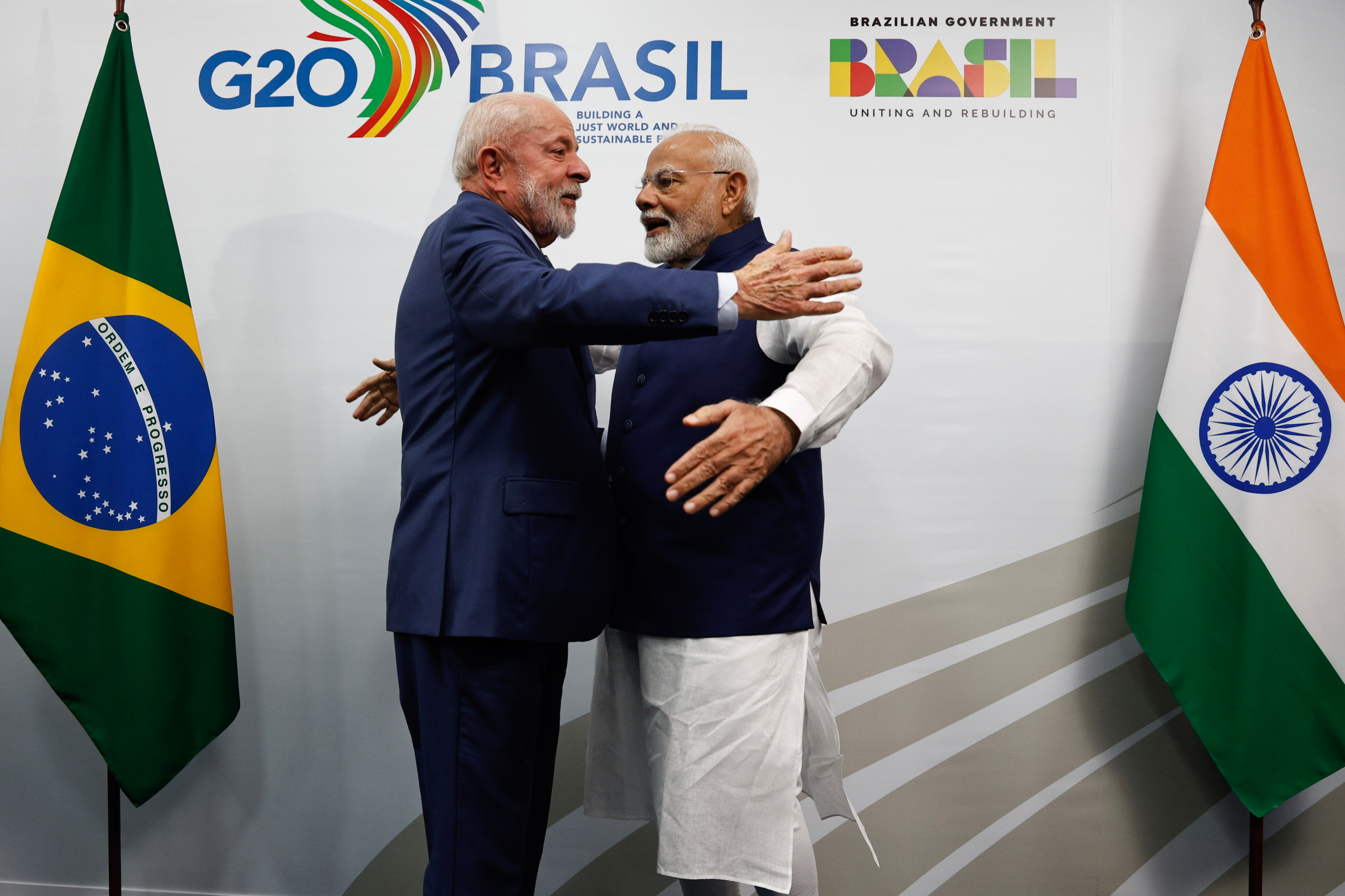
Brazilian President Luiz Inacio Lula da Silva wants to deepen trade ties with India, the world’s most populous nation. The question as he prepares to host Indian Prime Minister Narendra Modi in Brasilia on Tuesday is how to go about it.
Despite both nations being members of the BRICS grouping of emerging-market economies and natural allies in the fields of poverty reduction and biofuel production, India ranks well down the list of Brazil’s trading partners. Total commerce is dwarfed by that with China, the US, neighboring Argentina and faraway Germany.
It’s a mismatch that the president known as Lula acknowledged last week, when he joked that he’d only just learned that Modi, a devout Hindu, didn’t eat meat. Brazil is the world’s No. 1 beef exporter.

“Our trade relationship is just $12 billion, it’s nothing,” Lula said at an event. “So please, arrange a box of cheese. I want it on the table so he never complains about Brazilian food and, who knows, maybe he’ll start buying Brazilian cheese.”
With Donald Trump’s tariffs upending global commerce, Lula has spent months attempting to bolster trade relations with markets beyond Brazil’s traditional partners. Now he’s desperate to finally crack the code on a relationship that has never fully taken off, thanks to a litany of incompatibilities and the fact that Brazil and India often find themselves competing to sell the same goods.
Trade has accelerated in recent years, doubling since they formed the BRICS bloc with China, Russia and South Africa more than a decade ago. It grew by 24% over the first five months of 2025 from the same period a year ago, according to Brazil’s government.
But India and the 1.4 billion people who call it home still remain a largely-unrealized market for Brazil, an agricultural behemoth that has seen trade with China more than quadruple since BRICS launched in 2009, official data shows.
Brazil is looking to diversify exports to India beyond sugar and crude oil that dominate current sales. Earlier this year, Brazil’s Embraer SA – the world’s third-largest planemaker – established a subsidiary in New Delhi in a bid to broaden its presence in India’s defense and aviation sectors.
Brazil also wants to expand a preferential trade agreement India has with Mercosur, the South American customs union formed by Brazil, Argentina, Paraguay and Uruguay.
Latin America’s largest economy has spotted an opportunity in sesame, no matter that India ranks as one of the world’s leading producers of the seed. Sesame exports have grown significantly since the Indian market opened to Brazil in 2020, in part because the South Asian nation imports it during the offseason to meet domestic demand and fulfill export commitments.
It is also eyeing expanded ethanol exports, now that India is increasing the amount of the product it blends into gasoline. India currently has restrictions on ethanol imports meant to protect its own clean energy industry, but bilateral accords on the product are among the deals Lula’s government is aiming to reach with Modi this week.
“That opens up an interesting opportunity for Brazil in the biofuels agenda,” said Gustavo Ribeiro, head of market intelligence at the Brazilian Trade and Investment Promotion Agency, or ApexBrasil. “India is a major sugar producer but depending on the year and the size of the harvest, it sometimes imports sugar or even ethanol when there’s a shortage. So Brazil becomes a strong alternative supplier of either sugar or ethanol.”
Brazil has competition on that front: Modi’s government has spent months pushing for a trade deal with the Trump administration to avoid US tariffs, with Washington also seeking access to India’s massive market for its own ethanol.
After this week’s gathering in Rio de Janeiro, Lula will pass the rotating BRICS presidency off to Modi. The pair have used the bloc to bolster their ambitions of becoming permanent members of the United Nations Security Council, a goal they reaffirmed in Brazil and that is likely to be a priority for India in 2026.
In Brasilia, they’re expected to ink deals on renewable energy, counter terrorism, cooperation on agricultural research and agree on framework to protect confidential information. “These agreements have been finalized, and we’re hoping to sign,” India’s ambassador to Brazil, Dinesh Bhatia, told reporters Sunday.
The meeting is the first of two state visits Lula will hold in the wake of the BRICS leaders summit, with Indonesia President Prabowo Subianto coming to Brasilia on Wednesday.
Indonesia is central to Lula’s efforts to expand trade with members of the Association of Southeast Asian Nations, the 10-country bloc home to more than 600 million people. Brazil’s commerce with the region has boomed to $37 billion from about $3 billion over the last two decades, according to government data.
Lula’s government is aiming to open Indonesia – which registered about $6 billion in trade with Brazil last year – to poultry and expand beef exports, while also deepening bioenergy and defense cooperation, according to his administration. The Brazilian leader is expected to travel to Malaysia in October for an Asean summit.
For Prabowo, the visit is more than a commercial stop. Since taking office last October, he has adopted a more hands-on and high-profile foreign policy, focused on securing bilateral deals that deliver both economic and strategic gains.
Indonesia recently joined BRICS, and the trip to Brazil is part of a push to position Southeast Asia’s largest economy as a more active middle power with deeper ties across the Global South.