


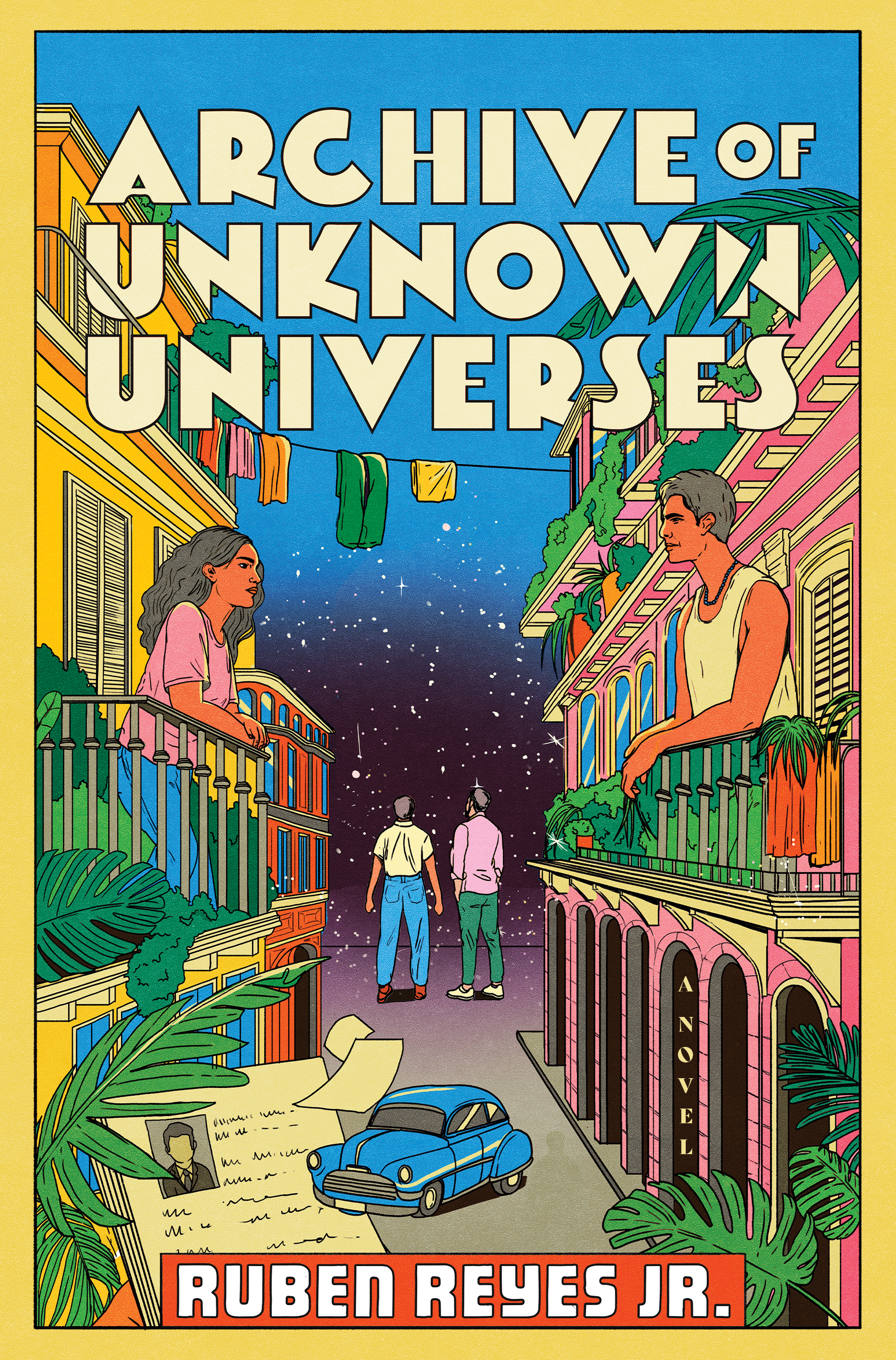
The Oscar-nominated film “Past Lives” was the wistful story of a love triangle. But the tension for its female protagonist was not simply between two partners but between two selves – a past in Seoul lived in Korean and a present as a New Yorker thriving in English. Suspended in that tension between here and there, its screenplay by director Celine Song was a classic work of immigrant fiction. Counterfactuals and imagined homelands have always haunted and inspired displaced artists. In his debut novel, “Archive of Unknown Universes,” the brilliant young writer Ruben Reyes Jr. turns that art of speculation into a riveting saga of answers.
In 2018, a widely available high-tech contraption called the Defractor allows users to easily sift through alternative timelines and “unknown universes.” The machine asks questions in chatbot form and then instantly produces projections of a life’s possibilities in high definition. But the Defractor is strictly prescribed for academic and professional research, given the emotional dangers of personal use. “For those with access to it, illicit use of the technology carried as much stigma as cocaine did,” Reyes writes. “There were stories of people who saw the technology as a one-stop solution for all their personal problems. Many had capsized their lives for a shot at the enlightenment they suspected could be found in their alternate lives.”
At Harvard University, a student of Salvadoran heritage named Ana can’t help herself. She’s stuck in a loveless relationship, which raises immediate what-ifs, but she’s also curious about silences and secrets from her family’s past. She tells herself she’s only using the machine for research for an upcoming trip to Havana to study communist revolutions. And yet, “as she stared at the blue neon light that shone through a quarter-size hole on the machine’s side, a pit formed in her stomach. There was no denying it: Ana was here for personal guidance.” What Ana sees not only changes the course of her relationship but also resurrects a love story from her family’s past.

Reyes juxtaposes Ana’s research in the present with a sensual parallel love story set in the 1970s between two men named Neto and Raphael. As Ana unearths Neto’s letters, Reyes renders them as a living, breathing universe in the present tense. The men meet as revolutionaries and begin a relationship that will span El Salvador, Cuba and California. In private moments, stolen from the brutal war and homophobia that surrounds them, they imagine an alternate universe where their politics and love are center stage. During a reprieve in the jungle, they swim, and Neto catalogues Raphael’s body: “the bulge of his pecs, the sharp edge of a hip, the slope of his armpit. Like a treasure trove bobbing in the wake of a shipwreck, Rafael shines. Neto wants to swim over and feel his skin. He imagines drying every inch with a towel, then leaning in to taste the algae on his lips.” As Ana will ask, “Before the internet, before the Higgs boson, before attention spans were shot short, had love been richer, fuller?”
Reyes, a graduate of Harvard and the Iowa Writers’ Workshop, gained attention last year when his story collection, “There Is a Rio Grande in Heaven,” was a finalist for an array of prizes. Spanning generations of Salvadoran families, queer, Latinx Californians and the contemporary politics of American xenophobia, it’s an extraordinary debut. Reyes possesses a sly self-awareness of class and a sharply critical view of linear immigrant success stories. His characters are survivors of migrations and dislocations, of elitist Ivy League campuses and racist border crossings. Their origins, orientations and legal statuses may make them minorities in America and Central America, but Reyes bestows them attention and grandeur. What distinguishes his writing form the realist dramas of fellow immigrant writers like Jhumpa Lahiri – also a short-story master – is the way Reyes remixes fantasy with politics, history with speculative, sexy futurism. In his fictional reality, Boston fades into Nicaraguan jungles, markets in East Los Angeles transition into oceanfront balconies in Havana.
Across the relatively short length of “Archive of Unknown Universes,” there is always a whirring sense of invention, weirdness and bold creative swings. Its robotics and pop culture references are irreverent and often very funny. Queerness is not only a central theme of Reyes’s work but a formal sensibility. A machine speaks directly to the reader in the voice of an omniscient deity in sporadic interludes. The same Defractor assumes the voice of Ryan Seacrest and Avril Lavigne in its more playful interactions with users sifting through heavy national histories. Narrative timelines become cyclic and disorienting before they reveal the novel’s moving architectural conceit. In what is a deeply adult novel of love and inheritance, there are youthful left turns and risky aesthetic swerves. The unpredictable mélange of genres and tones becomes Reyes’s way to both retain and reward his reader’s interest.
Robert Frost may have asked a fundamental question of American life with roads taken and not taken, but that idea has always assumed a cinematic, epic scale in immigrant writing. Stories of migrations span generations, languages, nations and choices by design. Reyes mines the physical and emotional borders between Central America, the Caribbean, California and Cambridge. But, with high-wire artistry, he also manages to convey deeply moving truths about the borders between past lives and future possibilities.
– – –
Bilal Qureshi is a culture writer and radio journalist whose work has appeared in The Washington Post, the New York Times and Newsweek, and on NPR.
– – –
Archive of Unknown Universes
By Ruben Reyes Jr.
Mariner. 288 pp. $28