



On Friday night, November 7th, I left for Jamshedpur, 250 kilometres away from my host location, to collect my bike that was being sent to the TATA railway station and to meet my co-Fellows and friends there. Julien and Sampriti, two BIF Fellows, are placed in Jamshedpur, and Dhanraj, a common friend of ours, is also from there.
India-USA Bhai Bhai
On Saturday morning, Dhanraj, together with his friends, had planned a small picnic for Julien and me near a dam about 60 kilometres away. There were seven of us in total, travelling on four bikes. The journey was thrilling and brought back memories of trips I had with my friends back home. I was amazed at how I was getting a homely feeling some 2300 kilometres away from home, in a city where I had never been before.


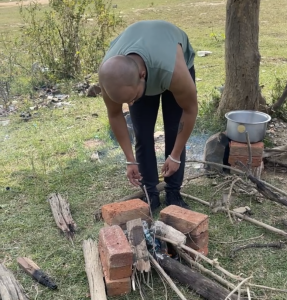
Even though Julien and I were new to the group, it didn’t take us long to get comfortable. We brought supplies and cooked breakfast and lunch on a makeshift Choola. The place was serene and peaceful, without the usual crowds at picnic spots. I shared stories about how we used to cook food during outings with friends back in Kerala, while Julien reminisced about picnics back home, cutting vegetables and cooking steak. As we were cutting vegetables, we compared the common ingredients used in our respective homes.

As the conversation deepened, the boys jokingly asked Julien to find love in America, promising to help him find his soulmate in India. It was a fun and light-hearted conversation that highlighted how, despite coming from different geographies, people of the same age group can bond easily over shared interests, passions, and aspirations. Social media and the internet have also provided us with numerous common grounds to connect over.

As the day progressed, our discussions touched on colonialism, politics, faiths, and culture, among other topics. This conversation revealed not only the differences in our perspectives and opinions but also how things we consider insignificant or petty can be strong convictions driving people forward. However, the biggest realisation from this experience was how, despite differences in geography, culture, language, and political views, we reassured each other that we are all each other’s Bhai (brothers) who would look out for one another.
Julien and I even received an invitation from one of our friends to visit Kolkata and spend Christmas with them. And I guess that’s how the network of Bhais and Behens (sisters) grows beyond familiar territories.
We Almost Found the Cure for Religious Intolerance

During the same weekend, Julien and I had the chance to visit two temples in Jamshedpur, one devoted to Shri Mata Vaishno Devi and the other to Sai Baba. On Sunday night, the three of us—Sampriti, Julien, and I—gathered at Sampriti’s place to catch up on each other’s lives. As we mentioned our temple visits, the discussion naturally turned to religion. To spoil the suspense: no, it didn’t explode; we’re still good friends. Julien shared his experiences with the Bahá’í faith back home and how it proposes that the foundations of all major religions are the same, with the founders of Hinduism, Buddhism, Christianity, and Islam all believing in the same God.

For some time, our discussion revolved around these recurring patterns across religions. The Abrahamic faiths—Judaism, Christianity, and Islam—believe in God and messengers sent to teach divine revelations to their respective societies and time periods. Buddhism speaks of different Buddhas from various historical ages, with Gautama Buddha being the Buddha of the current age. Jainism similarly describes 24 Tirthankaras throughout history, regarded as teaching gods. Sikhism identifies its ten Gurus as divine prophets who deliver God’s messages. In Hinduism, the Dashavatara (ten incarnations of Vishnu) are said to have come to earth to restore balance and protect the righteous. The theme of Prophets, Messengers and Reincarnations coming to deliver divine revelations exists in all major religions.
These recurring patterns become even more striking when we look closely. For example, the biblical story of Prophet Noah (Nuh) bears similarities to the story of Vishnu’s Matsya avatar, both involving saving people from a flood by building a vessel or ark. I believe such repeating themes can serve as a uniting thread for people of different faiths, helping them find common connections. This understanding could lead to the realization that religions are nothing but different verses of the same eternal song.

Amid these deep discussions, I also discovered something unexpected: the Asian resting squat is not something everyone in the world can do, as each of us took turns trying it with varying success. The next night, the three of us went out for a late-night chicken tikka roll, which was absolutely delicious.
The weekend in Jamshedpur was both eventful and deeply reassuring. While our differences often create divides among us, finding a shared thread of connection can bring us together. It’s the inability to recognise these commonalities in others that often makes them feel distant and unfamiliar. My three days in Jamshedpur reminded me of the power of these shared connections, reaffirming my belief in the threads that bind my circle even more strongly.
About the Author:
Mohammed Askar hails from the Kasargod district of Northern Kerala and is driven by his desire to give back to society. He is a teacher and tech entrepreneur committed to social change and community empowerment through education. He co-founded Buznez.com, an IT solutions provider for schools. Through his participation in ‘The Great Indian Treasure Hunt,’ an experiential learning program by Khoj India, Askar developed a deep understanding of India’s diverse social landscape and its pressing development needs. This journey has provided him with exposure to Agroforestry, Permaculture, Tribal Education and Gender Neutral Education. He has been pivotal in facilitating similar learning experiences for others and has volunteered with social development organisations in Maharashtra, Rajasthan, Madhya Pradesh, Bihar, Karnataka, and Kerala. Askar’s commitment to educational equity inspired him to co-found Prashiksha, an initiative addressing educational gaps for rural and migrant children in Tumkur, Karnataka. He remains deeply involved in local development efforts, such as the H2HT Tourism Alliance and the Anganwadi Welfare Committee. Currently, Askar is on a journey of unlearning and relearning from his five years of teaching, aiming to grow as an impactful education leader. He looks forward to serving with AIF’s Education program to develop teaching resources for government schools.


